· Independent guide
Pikobuy Shipping Cost Guide 2026
Pikobuy's shipping estimator asks for the destination, product type, weight and parcel dimensions. This guide explains what those fields mean and how to compare estimates without assuming one fixed price per kilogram.
What the Shipping Estimator Asks For
The current shipping cost page uses five inputs before checking available options:
- Destination country or region: where the parcel will be delivered.
- Product type: the item category used to check route eligibility and handling restrictions.
- Weight in kilograms: the estimated packed parcel weight.
- Length, width and height in centimeters: the estimated outside dimensions of the packed parcel.
- Check: the action used to return available route estimates for those inputs.
These fields make the model parcel-specific. A useful estimate needs more than item price or weight alone, because destination, contents and package size can change which routes appear.
How to Read the Quote Model
Start with your actual destination and choose the closest accurate product type. Then enter a realistic packed weight and dimensions. The estimator can use that combination to show logistics choices rather than presenting one universal shipping rate.
The Pikobuy beginner flow places route selection after the item reaches the warehouse and passes inspection. At that stage, the shopper chooses a suitable logistics route, submits the parcel and pays international shipping. Routes can differ in delivery time and billing method, so the cheapest-looking option is not automatically the most suitable one.
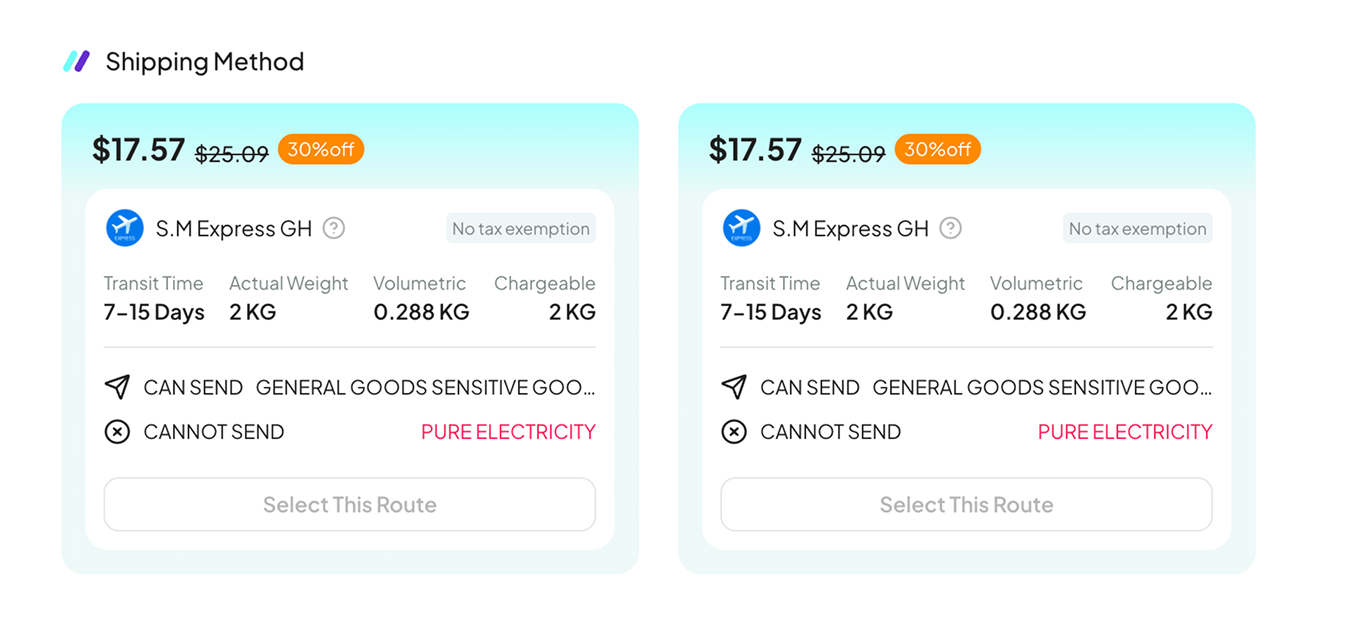
Actual Weight and Parcel Volume
Actual weight is only one part of a parcel quote. A large but light package can occupy more cargo space than a compact package of the same weight, which is why the calculator also asks for length, width and height.
Parcel volume is calculated as length × width × height. Some logistics routes convert that volume into a chargeable or volumetric weight using their own billing rules. The visible Pikobuy form does not publish one universal divisor, so do not hard-code a single formula for every route. Enter accurate dimensions and let the current route result show how the parcel is billed.
A Better Way to Make a Pre-Warehouse Estimate
- Select the country or region where the parcel will actually be delivered.
- Group the planned items by product type and note anything that may face route restrictions.
- Add the estimated item weights, then leave a reasonable allowance for the shipping carton and protective packaging.
- Estimate the packed outside dimensions rather than using only the dimensions of one product.
- Run the calculator again with a slightly heavier or larger parcel to see how sensitive the result is.
- After warehouse packing, compare the available routes again using the measured parcel details.
Why You Should Test More Than One Parcel Size
Suppose the same products could be packed in a compact carton or in a larger carton with bulky retail boxes. Keep the destination, product type and estimated weight consistent, then test both dimension sets. The comparison helps show whether reducing unnecessary packaging could matter for the available routes.
This is more reliable than copying someone else's shipping total. Two parcels with similar product prices can have different destinations, product types, packed sizes, route choices and promotional eligibility.
Checks to Make Before Paying
- Confirm the warehouse weight and outside parcel dimensions.
- Check that every item is allowed on the selected route.
- Compare estimated delivery time as well as the displayed shipping cost.
- Check whether optional packaging, reinforcement or removal services change size or weight.
- Review insurance, tracking and compensation terms where they are offered.
- Verify whether any coupon applies to the route and account before relying on the discount.
- Leave room for currency conversion, taxes or destination charges that may sit outside the estimator.
What the Estimate Does Not Guarantee
A calculator result is a planning figure, not a promise that every route, price or delivery time will remain unchanged. Final availability can depend on measured parcel data, item restrictions, current logistics conditions and the route offered when the parcel is submitted.
For that reason, use the estimator to compare scenarios before ordering, then use the warehouse measurements and current parcel page to make the final shipping decision.
Pikobuy Shipping Cost FAQ
Is the calculator result the final shipping price?
No. It is best treated as an estimate. The final selection is made after the warehouse has the parcel details and shows the routes available at that time.
Why does the estimator need parcel dimensions?
Dimensions describe how much cargo space the parcel occupies. Some routes may compare actual weight with a volume-based billing weight.
Why does product type matter?
Different item types can have different route eligibility or handling restrictions. Selecting an accurate type helps avoid an unrealistic estimate.
Can I estimate shipping with one fixed price per kilogram?
A fixed per-kilogram guess can miss destination, package volume, product restrictions and route-specific billing. Use the current calculator inputs instead.